
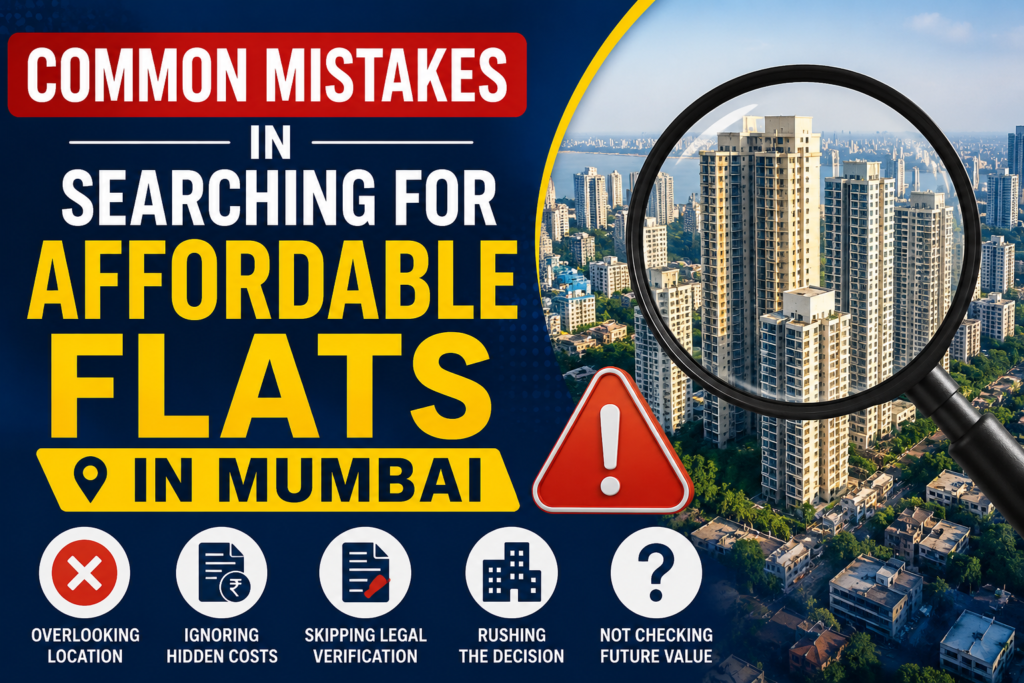
Finding a home in Mumbai can be both exciting and overwhelming. The city offers an extraordinary range of residential options, from compact apartments in well-connected suburbs to larger homes in emerging neighbourhoods. Yet, the search for reasonably priced housing often becomes complicated by soaring demand, limited inventory, fluctuating prices, and intense competition among buyers.
For many first-time buyers, affordability is interpreted simply as a low purchase price. That assumption can be misleading. A property that appears inexpensive at first glance may involve substantial maintenance charges, renovation expenses, registration costs, parking fees, or inconvenient commuting requirements.
Whether purchasing a home for personal use or considering it as a long-term asset, buyers need a methodical approach. The following are some of the most common mistakes people make while searching for Affordable Flats in Mumbai, along with practical ways to avoid them.
1. Focusing Only on the Advertised Price
One of the most prevalent mistakes is judging a property exclusively by its quoted price.
A flat advertised at ₹50 lakh may appear considerably cheaper than another property priced at ₹55 lakh. However, the actual financial commitment can differ substantially once additional expenses are considered.
Buyers should account for:
- Stamp duty
- Registration charges
- Brokerage
- GST, where applicable
- Parking charges
- Maintenance deposits
- Society charges
- Legal verification expenses
- Interior and renovation costs
- Moving expenses
- Loan processing and other banking charges
The headline price is merely the first figure in the equation. The more meaningful metric is the total acquisition cost.
Before making an offer, calculate the complete expenditure and compare properties on that basis.
2. Ignoring the Location-Connectivity Equation
Mumbai is a city where geography directly affects lifestyle.
A seemingly affordable apartment located far from a railway station, metro line, major road, workplace, or educational institution may ultimately prove expensive in terms of time and transportation.
A buyer should examine the property’s proximity to:
- Local railway stations
- Metro stations
- Bus routes
- Major highways
- Schools and colleges
- Hospitals
- Markets
- Employment hubs
- Essential civic facilities
An apartment that saves ₹5 lakh but adds two hours to the daily commute may not represent genuine affordability.
The concept of value extends beyond square footage. Convenience, accessibility, and time are economic resources too.
3. Not Establishing a Realistic Budget
Another frequent mistake is beginning the property search before establishing a realistic financial ceiling.
Buyers sometimes calculate affordability based solely on the maximum home loan a bank might approve. That is risky. Loan eligibility does not necessarily equal comfortable repayment capacity.
A sensible budget should consider:
Down Payment + Loan EMI + Additional Property Expenses + Emergency Reserve
It is also prudent to account for future changes in income, family responsibilities, interest rates, and recurring household expenses.
Ideally, buyers should retain an emergency fund rather than exhausting their savings for the down payment. Homeownership should provide stability, not create perpetual financial strain.
4. Comparing Properties Without Comparing Specifications
Two apartments can have identical asking prices while offering very different value.
For example, one property may provide a larger carpet area, better natural ventilation, dedicated parking, stronger building amenities, and superior connectivity. Another may have a lower price but significantly less usable space.
Mumbai buyers should pay particular attention to carpet area, rather than relying exclusively on built-up or super built-up measurements.
When comparing homes, evaluate:
- Carpet area
- Floor level
- Building age
- Number of bathrooms
- Balcony availability
- Parking
- Natural light
- Ventilation
- Water supply
- Lift facilities
- Security
- Maintenance costs
- Society infrastructure
A systematic comparison prevents attractive advertisements from distorting the decision-making process.
5. Neglecting the Legal Verification Process
A low-priced property can become an expensive mistake if its documentation is problematic.
Before paying a substantial token amount, buyers should conduct appropriate legal due diligence. Depending on the property and transaction, relevant documents may include:
- Title documents
- Sale agreement
- Previous sale deeds
- Encumbrance-related records
- Approved building plans
- Occupancy Certificate
- Completion Certificate, where applicable
- Property tax records
- Society documentation
- Loan or mortgage information
- Required permissions and approvals
For under-construction projects, buyers should also verify the project’s registration and details on the relevant regulatory platform.
Legal verification is not an ornamental step in the buying process. It is a protective mechanism.
6. Being Tempted by Unrealistically Low Prices
If a property appears dramatically cheaper than comparable homes in the same locality, buyers should investigate why.
There may be a perfectly legitimate reason, such as:
- Urgent sale
- Older construction
- Smaller carpet area
- Limited amenities
- Interior renovation requirements
- Less desirable floor
- Poor connectivity
But there could also be unresolved legal, structural, financial, or ownership issues.
A bargain deserves scrutiny, not immediate celebration.
Instead of asking only, “How cheap is this flat?” ask, “Why is this flat priced this way?”
That single question can reveal important information.
7. Skipping the Physical Property Visit
Online property listings have made apartment hunting considerably easier, but photographs cannot replace a physical inspection.
Images can conceal problems involving noise, ventilation, water pressure, road congestion, construction activity, or the surrounding neighbourhood.
A physical inspection should ideally be conducted at different times of the day.
Look for:
- Traffic noise
- Water availability
- Mobile network coverage
- Natural lighting
- Ventilation
- Dampness
- Cracks
- Leakage
- Lift condition
- Parking accessibility
- Neighbourhood cleanliness
- Nearby construction
- Street lighting
The surrounding environment matters almost as much as the apartment itself.
8. Forgetting About Future Expenses
Buying the apartment is only the beginning.
Homeowners may subsequently face expenditures related to repairs, interiors, appliances, painting, furniture, society contributions, property taxes, and maintenance.
Older buildings can require particularly careful financial planning because major repairs or redevelopment-related contributions may arise.
Buyers should therefore ask about:
- Current monthly maintenance
- Recent major repairs
- Planned society projects
- Building renovation
- Redevelopment discussions
- Sinking fund
- Water and electricity arrangements
A property with a low purchase price but high recurring expenditure may not be genuinely economical.
9. Choosing a Property Solely Because It Is New
New construction has obvious advantages, but “new” does not automatically mean “better.”
A newly constructed apartment may have modern amenities and contemporary architecture, yet an older property in an established neighbourhood may offer better connectivity, larger rooms, mature infrastructure, and stronger social amenities.
Buyers should compare properties based on actual utility rather than construction age alone.
In some cases, a well-maintained older apartment can provide better overall value than an expensive new development.
10. Overlooking Resale and Rental Potential
Even if the intention is to live in the apartment, future circumstances can change.
A job transfer, family expansion, financial requirement, or relocation may eventually lead to selling or renting the property.
Consequently, buyers should consider the property’s long-term marketability.
Factors that can influence resale and rental potential include:
- Connectivity
- Local infrastructure
- Employment proximity
- School and hospital access
- Building condition
- Apartment configuration
- Floor
- Parking
- Neighbourhood development
A property should ideally satisfy today’s requirements without becoming an illiquid asset tomorrow.
11. Making a Decision Under Pressure
Mumbai’s property market can create a powerful sense of urgency.
Statements such as “Only one flat remains” or “The price will increase tomorrow” can push buyers into making premature decisions.
While genuine opportunities can disappear, a home purchase should not be treated like an impulsive retail transaction.
Buyers should verify the property, understand the financial implications, inspect the documentation, and negotiate where appropriate before committing.
Pressure can cloud judgment. Due diligence restores clarity.
12. Failing to Negotiate
Some buyers assume that property prices are completely non-negotiable.
That is not always the case.
Depending on the seller, property type, market conditions, and transaction circumstances, there may be room to negotiate the price or associated charges.
Instead of making an arbitrary offer, research comparable properties and understand prevailing prices in the locality.
Negotiation can potentially involve:
- Sale price
- Parking
- Maintenance deposits
- Certain additional charges
- Furniture or fixtures
- Payment schedule
A well-informed buyer negotiates from evidence rather than emotion.
13. Not Working With Reliable Property Professionals
The Mumbai property market is extensive and complex. Navigating it without reliable assistance can be particularly challenging for first-time buyers.
Professional property consultants can help buyers identify suitable options, compare localities, understand pricing, coordinate property visits, and navigate aspects of the transaction.
For buyers seeking guidance, Auric Realtors Consultants can be considered as part of the property-search process, particularly when evaluating residential opportunities and comparing available options.
However, buyers should still independently verify property documentation and financial obligations before entering into a transaction.
Professional assistance should complement due diligence, not replace it.
14. Ignoring the Neighbourhood’s Future Development
Today’s neighbourhood may look very different five or ten years from now.
Upcoming infrastructure projects, roads, metro connectivity, commercial developments, educational institutions, and redevelopment initiatives can influence property values and livability.
Conversely, excessive construction, traffic congestion, inadequate infrastructure, or environmental concerns may negatively affect a locality.
Therefore, buyers should examine both the present condition and the future trajectory of the area.
The objective is not merely to purchase a flat. It is to purchase a sustainable living environment.
15. Letting Emotions Override Financial Logic
Buying a home is inherently emotional.
A beautiful living room, attractive balcony, modern kitchen, or impressive lobby can create an immediate attachment to a property. But emotional appeal should not overshadow practical considerations.
Before committing, ask:
- Does it fit the budget?
- Is the location suitable?
- Is the carpet area adequate?
- Are the documents satisfactory?
- Are maintenance costs manageable?
- Is the building structurally and legally sound?
- Does the property meet long-term requirements?
A property can be aesthetically appealing and financially unsuitable at the same time.
A Practical Checklist for Mumbai Homebuyers
Before finalising an affordable apartment, consider this simple checklist:
Financial
- Establish a realistic budget.
- Calculate total acquisition costs.
- Keep an emergency reserve.
- Evaluate EMI affordability.
Property
- Verify carpet area.
- Inspect construction quality.
- Check water, electricity, lifts, parking, and ventilation.
- Examine maintenance requirements.
Legal
- Verify ownership and title.
- Check applicable approvals.
- Review relevant property documents.
- Obtain professional legal advice where necessary.
Location
- Check transportation connectivity.
- Examine nearby schools and hospitals.
- Visit the locality at different times.
- Investigate future infrastructure development.
Long-Term
Think about changing family and professional requirements.
Consider resale potential.
Evaluate rental demand.
Estimate future maintenance.